From Wikipedia:
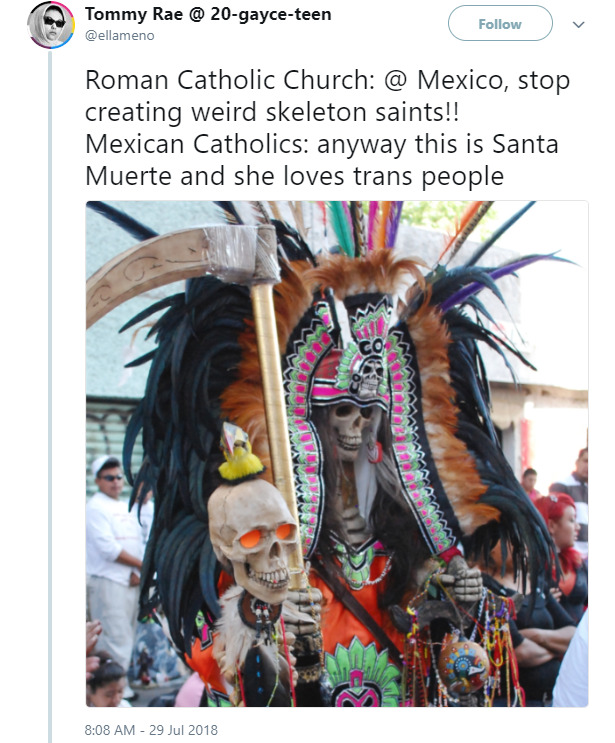
Nuestra Señora de la Santa Muerte (Spanish for Our Lady of Holy Death), often shortened to Santa Muerte, is a female deity or folk saint in Mexican and Mexican-American folk Catholicism. A personification of death, she is associated with healing, protection, and safe delivery to the afterlife by her devotees. Despite condemnation by the Catholic Church, her cult has become increasingly prominent since the 2000s.
The worship of Santa Muerte is condemned by the Catholic Church in Mexico as invalid, but it is increasingly firmly entrenched in Mexican culture.
Santa Muerte is also seen as a protector of homosexual, bisexual, and transgender communities in Mexico, since many are considered to be outcast from society. Many LGBT people ask her for protection from violence, hatred, disease, and to help them in their search for love.
Her intercession is commonly invoked in same-sex marriage ceremonies performed in Mexico. The Iglesia Católica Tradicional México-Estados Unidos, also known as the Church of Santa Muerte, recognizes gay marriage and performs religious wedding ceremonies for homosexual couples.
Man how did I not know about this magical gay skeleton queen until today?
Some more history of Santa Muerte:
Though the origins of the worship of Our Lady of Holy Death are subject to debate, it is most likely a syncretism between pre-Columbian Mesoamerican religion and Spanish culture. Mesoamerica had always maintained a certain reverence towards death, which manifested itself among the religious practices of ancient Mexico, including in the Aztec religion. Death was personified in Aztec and other cultures in the form of humans with half their flesh missing, symbolizing the duality of life and death. From their ancestors the Aztecs inherited the gods Mictlantecuhtli and Mictecacihuatl, the lord and lady of Mictlan, the realm of those dead who died of natural causes. In order for the deceased to be accepted into Mictlan, offerings to the lord and lady of death were necessary. In European Christian tradition, many paintings employed skeletons to symbolize human mortality.
INAH researcher Elsa Malvido Miranda notes that the worship of skeletal figures has precedent in Europe during times of epidemics. They would be dressed up as royalty with scepters and crowns, and be seated on thrones to symbolize the triumph of death. In Latin America, the human skeleton was used to remind Catholics of the need for a “holy death,” (muerte santa) fully confessed of sins. As relics, bones are also associated with certain saints, such as San Pascual Bailón in Guatemala and Chiapas.
After the Spanish conquest of the Aztec Empire, the worship of death diminished but was never eradicated. John Thompson of the University of Arizona’s Southwest Center has found references dating to 18th-century Mexico. According to one account, recorded in the annals of the Spanish Inquisition, indigenous people in central Mexico tied up a skeletal figure, whom they addressed as “Santa Muerte,” and threatened it with lashings if it did not perform miracles or grant their wishes. Another syncretism between Pre-Columbian and Christian beliefs about death can be seen in Day of the Dead celebrations. During these celebrations, many Mexicans flock to cemeteries to sing and pray for friends and family members who have died. Children partake in the festivities by eating chocolate or candy in the shape of skulls.
In contrast to the Day of the Dead, overt veneration of Santa Muerte remained clandestine until the middle of the 20th century. When it went public in sporadic occurrences, reaction was often harsh, and included the desecration of shrines and altars. At the beginning of the 20th century, José Guadalupe Posada created a similar, but secular figure by the name of Catrina, a female skeleton dressed in fancy clothing of the period. Posada began to evoke the idea that the universality of death generated a fundamental equality amongst man. His paintings of skeletons in daily life and that La Catrina were meant to represent the arbitrary and violent nature of an unequal society.
This is great acdemic information. However, as a Native Mexican Anthropologist I have to say that its more about the cultural aspect of this article that’s problematic.
Santa Muerte isn’t for non-Mexican/White consumption and the cultural ties go deeper than the historical aspect you mentioned here. She is not a “Gay Magical Skeleton” and shouldn’t be approriated by the entire LGBTQIA community. This article is full of missinformation and I kind of feel like white people in general need to keep their hands off this topic. A larger percentage of us Mexicans who understand the cultural as well as the acedemic implications of who Santa Muerte is agree.
Thank you for this addition. Don’t appropriate closed cultural and religious practices, y’all. You can learn about it, appreciate it, and gain a deeper understanding of it, but it’s not yours to accessorize or play with. Not everything is for your consumption.
Exactly and if you read the notes you see so many non-Mexican/white LGBTQIA people doing just that. This is something I deeply hate about my community. White LGBTQIA’s are SO quick to jump on the exoctification of PoC culture or iconography but then in the same breath practice overt racism and appropriation.
Being a gender and sexuality minority doesn’t give you access to People of Colors cultures, traditions, or iconography. Especially Santa Muerte wearing her image is actually dangerous since it’s used by the cartles and also she grants your desires but with a heavy price. I respect her but I don’t worship or pay homage to her.
My families personal Goddess is
Coatlicue she is who we pay homage too and have on our oferenda.That last part!! If you’re not part of the culture and are white, don’t fuck with la Santa Muerte. Part of why I kinda grew up afraid of her is cause whatever you ask for always comes at a price. Clueless ppl are gonna fuck their lives up if they’re not careful tbh.
@df-lr I was taught the same! I can remember being in Mexico during a festival and seeing a Santa Muerte festival and my Abuelita was like never worship her or ask her for anything because she asks for a steep price. I was taught to respect and laugh at death like everyone else but worshipping her is bad news imo.
This “no white people allowed” is upsetting to me from an anthropological standpoint. Agreed, if you’re not Mexican you shouldn’t worship Santa Muerte. But many Mexicans are white or mixed with white, and even though they in Mexico are “the oppressors” from Spain they’re still part of the culture now. We shouldn’t apply American concepts to other countries.
I mean you’re right pretty much anyone who isn’t indigenous from Mexico is probs mixed with German or Spanish descent so they’re mestizx. Also it’s shitty to speak over people from that culture who are trying to warn y’all not to mess with stuff you know nothing about. People are gonna follow what they think is cool and fine so what but if Santa Muerte comes at your door then that’s on y’all.
I’ve seen this post come around a couple times now and was Uncomfortable without further commentary from folks with more claim to cultural authority than myself so please take note of further commentary. I’m white and grew up on the border, fairly steeped in a lot of this stuff, doing Day of the Dead and surrounded by Mexican Catholic iconography, but I still know I have no claim to this. Seriously, she is not a magical gay skeleton queen, she’s something you absolutely do not mess with if you don’t have the full cultural context and even then you don’t mess with her or her sociocultural baggage lightly.
You don’t mess with her. I’m white and not Mexican. Don’t. Do it.
Adding to this to mention that in mexico, she is also mostly worshipped by drug lords and cartels. In my small town and surrounding areas, drug lords would barge into the sanctuaries of curanderas who worked with saints and demand that they put up a Santa Muerte, with the consequence for not doing so being anywhere from a beating to a kidnapping to death. In one town about 2 hours away, they broke into a Catholic Church, knocked down the statues of Jesus and the Virgin Mary, beat the priest to a pulp, and placed an image of La Santa Muerte on the altar. In a stream near my home, we discovered a hidden Santa Muerte with some additional trinkets pointed at my uncle’s house. It was a curse to get my aun and uncle to lose all their money and divorce. At the time they were having numerous problems and my aunt was convinced he was cheating on her. Somebody found the statue, we called an expert who told us to place the statue in a bag without touching it and bury it head down as deeply as we could, and then cleanse the area with holy water. My aunt and uncle’s problems virtually dissappeared.
I’m not saying that she is inherintly bad, but La Santa Muerte does indeed ask for a steep price, the kind that good people would not think is worth paying, but people with bad intentions and cruel hearts and twisted ambitions have no issue paying. In my part of Mexico, worshipping La Santa Muerte is seen as something done by bad people, so the sociocultural image is not something that you want to be associated with. She is someone whose existence we respect and whose precense we fear. As a member of the lgbtq community, I would never in my life ask for anything from her because it is not worth the price on my soul, thank you very much.
I know the Catholic Church does not apporve at all of lgbtq, but that’s not their main reason for not accepting La Santa Muerte into the church. Catholicism accepts death as a part of life, and as a transition into our souls’ eternal life, but not as something to be worshipped. Also, they accept the only saint that people use to effectively curse other people.
 A Force Sensitive Phasesixer