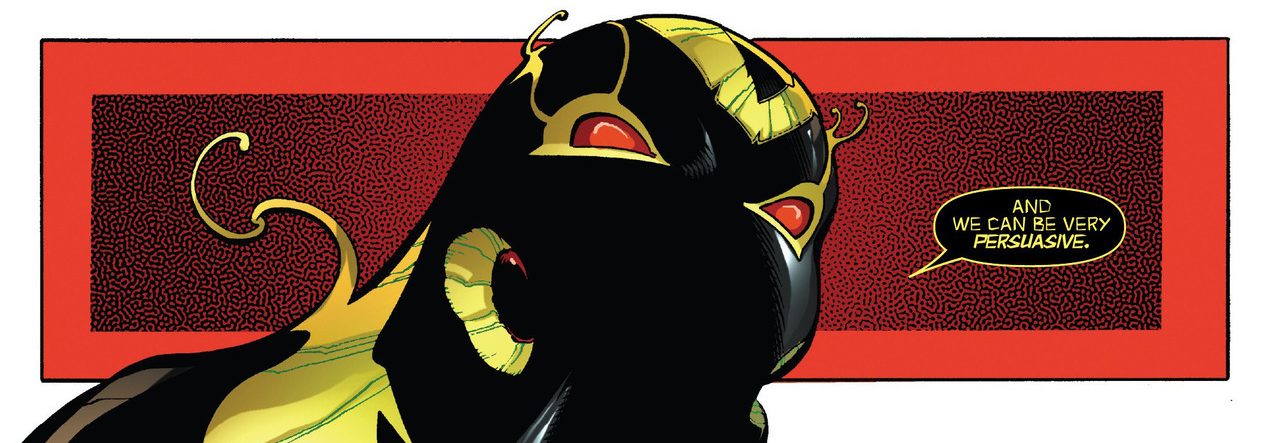
The number of times the symbiote corrects Eddie into thinking of them as a unit, a single, combined entity, shows so much about how they differ in their worldviews. Like Eddie so obviously really, really struggles with the concept, because on our planet there is me and there is you and we are all separate individuals with names and identities. But for the symbiote, not only is it normal, it’s so right and necessary and fundamental to its identity, that it actively goes out of its way to correct Eddie in the same way we would correct someone who used the wrong gender pronoun for us. Like even the concept of “I”, a unique, lone individual connected to nothing and no one–no hive, no host–it’s so strange and foreign, the symbiote doesn’t even like to say it.
And I know this creates a massive problem for fic writers!! I know that we kind of do need it to have a name and a singular pronoun like “he” or “it”. Because we’re just dumb humans and it’s the very best we can do.
I know that Cates is probably going to give it a name, which will definitely resolve a lot of issues when writing dialogue between the two (I mean for us, fanfic writers, not him) but the more I think about it, the more it feels like that would just be odd and strange to a symbiote. Like, what? I’m #24546, I’m completely unimportant, but let me talk about my hive and my brood and broodmates and my host-pairing because that’s what’s really important, the “us”.
So like obvs I’m going to keep using “I” when “we” won’t work, and I’m going to refer to the symbiote as Venom for clarity’s sake, because I’m a dumb human doing the best I can with a Klyntar’s worldview…but I think that, if it were real, the symbiote would be super offended to even read a narrative that separates it from Eddie. It would be as offensive as misgendering a trans person, something that really, really bothers it to the point it has to correct people.
This got me thinking, when the symbiote said “I love you”, does it felt the need to emphasis the symbiote part of them who loves their human part because it’s not “we love us/ourself” as a form of love toward a good symbiosis relationship where both parties are satisfied by the benefits, but a more distinct and personal form of love that’s usually not present between a symbiote and their host. But other then that particular occasion, the use of “I” would be seen by the symbiote (and most Klyntarians) as dismissing their existense (?) identity (?) as being half of an whole (?)
The irony is that the original post recommends to delete the app and reinstall it to fix their screw up, but today if you did that you’d be SOL because their latest screw up has caused the app to be removed from the App Store 😂🙌🏼
Few artifacts can evoke the golden, kaleidoscopic wonderland of childhood like a beloved plaything. The mere sight of a threadbare doll or a well-worn, well-loved action figure can transport us back to a time when life was new and boundless and filled with beauty and magic and discovery beckoning at every turn. A child’s toy isn’t merely a lifeless assemblage of metal and plastic and molded polycarbonate. A child’s toy is a vessel for creativity and joy and imagination. A child’s toy is something that’s deeply loved, and that which we deeply love becomes a part of us.
That’s what the Transformers meant to me. I was nine years old when the Autobots and Decepticons thundered into my world. An ancient race of enormous sentient space robots brought their age-old conflict raging down to Earth and into my imagination. They were unlike anything I’d ever seen before. And they were awesome. I spent countless hours playing with my Optimus Prime action figure, trying and failing to conjure Peter Cullen’s fixture-rattling voice as I’d lead a noble charge of Autobots across my cluttered bedroom floor. I’d collapse and reshape Megatron’s forbidding form into a deadly Walther P38 handgun, laying waste to the traitorous Autobots and looking over my shoulder for that scheming Starscream (and occasionally pretending I was James Bond). But no Transformer captivated my interest as much as Bumblebee.
Bumblebee was a humble yellow Autobot scout who took the alt form of a VW Beetle, of all things. He wasn’t flashy. He wasn’t striking. By Transformers standards he was small and callow and not particularly powerful. But he was the Transformer with the greatest affinity for humanity. He was the one who was most like us. He was the one who was most like me.
At home, nestled in my room, surrounded by teetering stacks of tattered paperbacks, splashy comic books, and warped VHS tapes, I would lose myself creating Bumblebee’s stories. Together we wandered through faraway lands, grappling with the evil Decepticons, running high-wire reconnaissance missions, and racing through canyons of disused cardboard boxes. For a lonely child of the ’80s, Bumblebee wasn’t just an overworked, scuffed up plastic toy. He was fully alive. And he was a part of me.
Thirty years later, I have the amazing opportunity to breathe life into Bumblebee once more. Only this time, I get to share our story with the world. But our story is going to be a little different.
Five films into the TRANSFORMERS series, audiences have come to expect a certain kind of cinematic experience from the franchise: expansive, muscular storytelling with jaw-dropping spectacle, high-octane action, cutting-edge visual effects, and giant rock ’em sock ’em robot battles. And explosions. Lots and lots of explosions. BUMBLEBEE represents a dramatic shift from that template. This film is an intimate, deeply personal, character-driven love story that plays out like a classic Amblin movie from the ’80s. With explosions Lots and lots of explosions.
Well, maybe not that many. Because while BUMBLEBEE has plenty of white-knuckle thrills, sci-fi insanity, and pulse-quickening feats of derring-do, this film evokes and pays tribute to those indelible qualities of the Transformers of my childhood. And for me, that meant magic. Wonder. Imagination. And love.
And it all began with a child’s plaything.
I hope the enclosed toys shine a light into the darkened, cobwebbed corners of your youth, evoking beloved memories of your own. And I can’t wait to share some of mine with you when BUMBLEBEE races into theaters this Christmas. It’s a story thirty years in the making.
Cheers,
Travis Knight
Director, BUMBLEBEE
I HAVE GREAT HOPE THIS MAN SOUNDS LIKE HE ACTUALLY LOVE TRANSFORMERS
Some dude bro on the internet talking about the new She-Ra reboot: Ugh SJWs are taking over cartoons and making them all preachy. I hate it when shows try to push an agenda on kids. Why can’t they be like they used to be, you know?
Original He-Man, looking straight at the audience: We had a lot of fun here today, but you know what isn’t fun? Judging others based on how they look. Not liking a person because he or she is a different race or religion is wrong. Also, plant a tree, and don’t do drugs.
Lou Scheimer was born to a German Jewish family and believed that his cartoons had a responsibility to teach children kindness and respect for everybody.
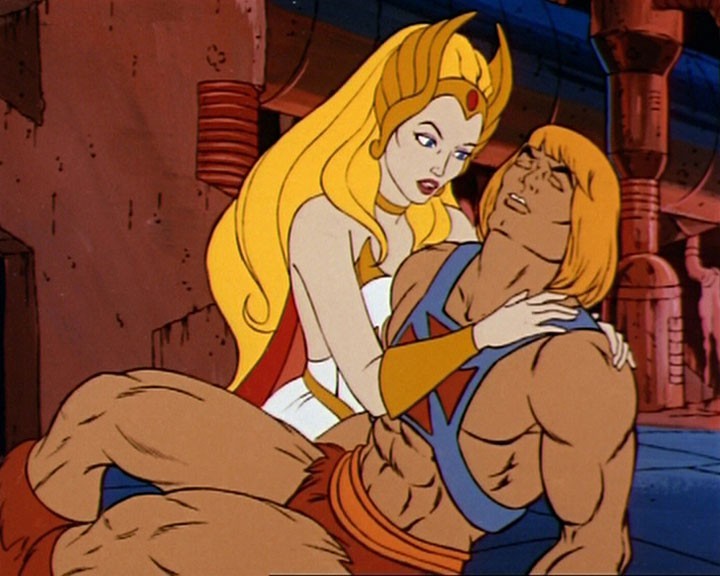
Back then there were also MILITANT divides between “boy’s” and “girl’s” entertainment but when he found out He-Man had at least a small following of little girls he pitched the concept of He-Man’s sister She-Ra and was insistent she be as tough a warrior as her brother. He saw that girls actually did like “scary” sword and sorcery and had a WHOLE NEW FUCKING SHOW made so they could feel acknowledged and have a heroine to look up to with her very own series.
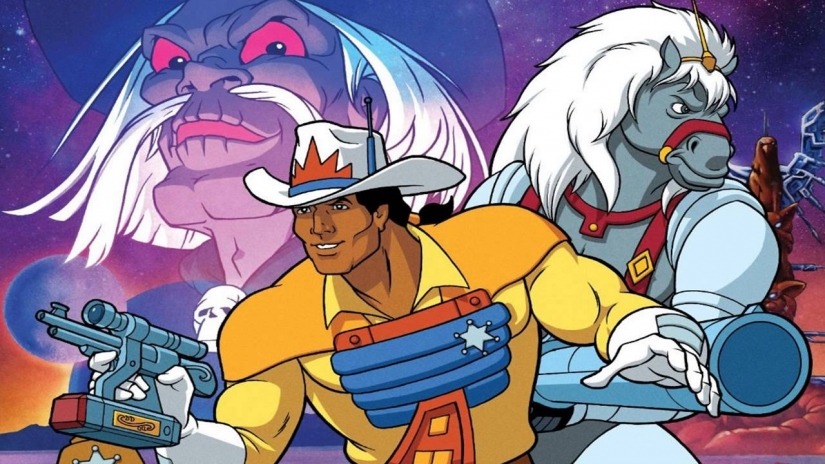
Later he would help design a whole new sci-fi fantasy setting with the most creative control he ever had, Bravestarr, and was adamant that the hero be a Native American man, the first ever in a starring role on a kid’s action show. He also wanted Bravestarr to be a positive role model by being a patient, gentle, soft spoken man who abhors violence and avoids using guns at all costs.
These cartoons are remembered as schlocky toy commercials and they ARE entertaining that way but real love went into them by a guy who wanted kids to grow up more sensitive and caring. Some of these same geeks crying about THE SJW’S were raised by even more bluntly progressive media than we’ve almost ever had and they didn’t even know it.













 A Force Sensitive Phasesixer